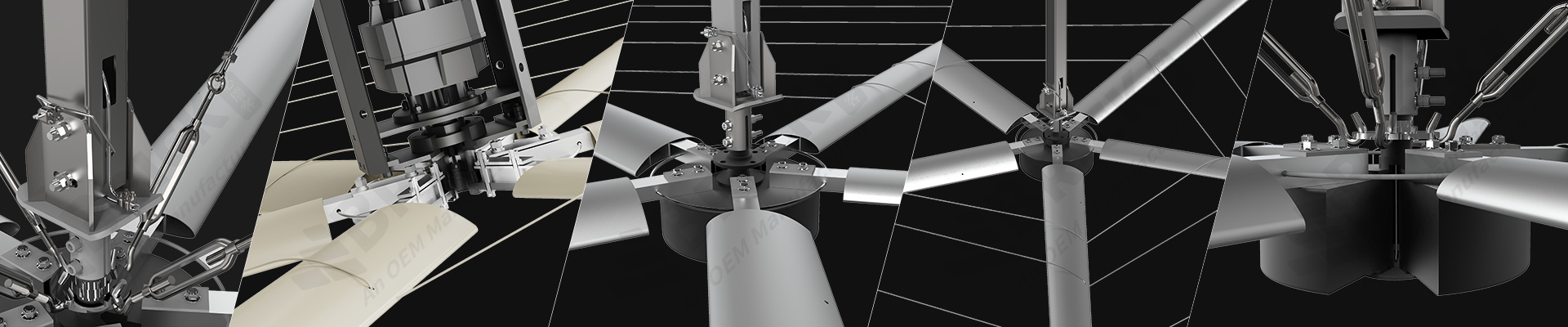
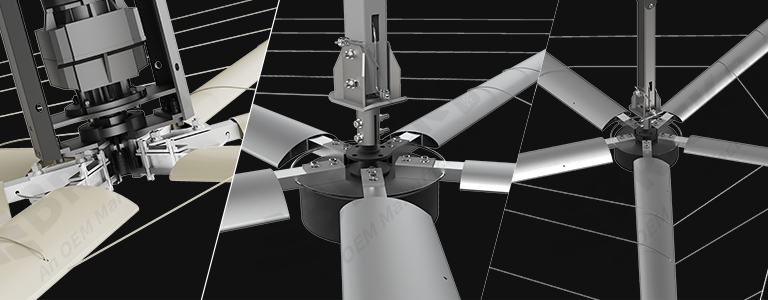
Basic data | Minimum height from blades to ground: ≥ 3.1 meters. (Reference: U.S. Standards) Minimum clearance from blades to flat roof surface: ≥ 0.9 meters. When installed position has crane, the minimum clearance from blades to the crane ≥ 0.3 meters. General spacing between two fans: 4D to 5D, here the D is the fan diameter. |
Motor selection | Two kinds of motors available for HVLS fans: PMSM Motors and Geared Motors. For applications with low-noise requirement or where quiet operation is desired, the PMSM Motor is recommended. For workshops where durability and safety are the priority, the 4 blade fans/ Classic Model with (German) Geared Motor is recommended. Both the PMSM Motor and the (German) Geared Motor are maintenance-free and do not require lubricant replacement. |
Power Vs attack angle | Without a specific airfoil profile, the recommended angle of attack for constant-cross-section blades is 12-18° based on the relevant literature. For Brick Classic Model, the 4-blade design with a tapered airfoil has an angle of attack of 16°, while Regular Model with constant-cross-section blade has an angle of attack of 13°. The angle of attack is related with airflow circulating and effective coverage, static pressure (perceived wind intensity) and power consumption. Solely pursuing low angle of attack—even to as low as 6°–8°—might be misleading by its airflow sensation and low power consumption, but no guarantee for overall ventilation and cooling performance. |
Interior height Vs fan diameters | For interior heights below 6 meters, Lightweight Model series is recommended, with diameters available at 4.9/4.6/4.3/4.0/3.7/3.3 meters. The primary consideration is that large-diameter fans at low heights can create a visually oppressive feeling. Moreover, installing large-diameter fans at low elevations offers limited effectiveness and poor cost efficiency. For heights between 8-14 meters, Classic or Regular model, 7.3-meter diameter are recommended, with the length of extension tube adjusted to maintain a blade-to-ground clearance of 7-10 meters. For heights above 16 meters, Classic Model with a 4.9-meter diameter is recommended. The main objective is to increase rotational speed and enhance static pressure to ensure effective airflow at ground level. In cases where the clearance between a crane and the roof beam is 0.8-1.5 meters, Brick recommends downsizing the fan diameter—for example, replacing a 7.3-meter model with a 6.1-meter model. The primary reason is to increase wind speed and static pressure, ensuring adequate airflow intensity at ground level. According to relevant literature, when the rotational speed of a 7.3-meter diameter fan is increased by 10% or 20%, the stress on the bolt connections increases by 20% and 40%, respectively. Relying solely on increasing rotational speed to compensate for insufficient air intake space poses safety risks. In spaces with very high ceilings, such as those above 18 meters, Brick does not recommend simply extending the length of extension tube to lower the fan blades. When the length exceeds 4 meters, the stability of the extension tube itself must be carefully considered. |
Other recommendations | For loading and unloading operations inside cargo box, where high temperatures and stuffiness, Brick Dock Fan with long airflow throw is recommended. To accommodate on-site different installations, different mount kits are employed, including roof-mounted, side door pillar-mounted with foldable arm, and mobile dock fan etc. Customized solutions are also available upon request. For indoor spaces with a height exceeding 20 meters, or where the clearance between the crane and the roof beam is less than 800 mm, the installation of pivot fans is recommended. In workshops with heat-generating equipment where on-site operators require ventilation and cooling, the mobile fans or pivot fans is recommended |