 Product Q&A
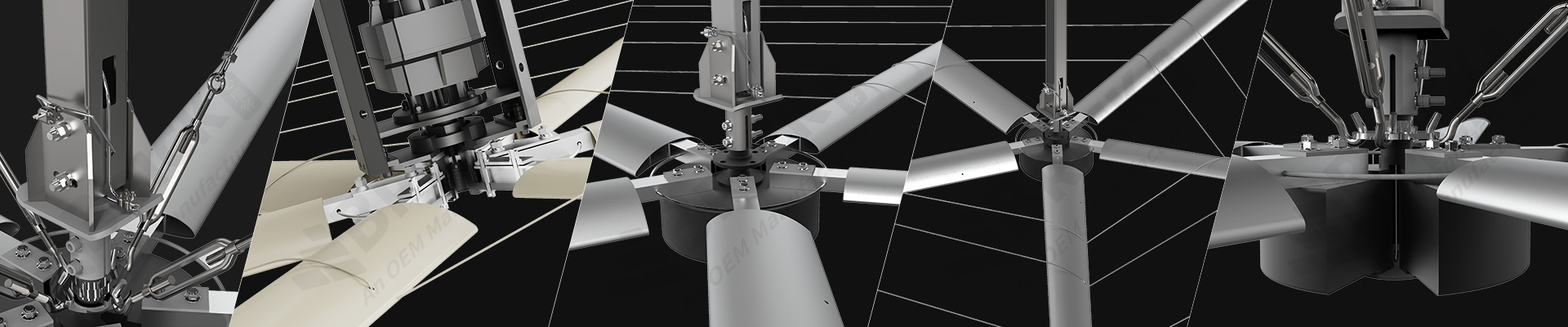
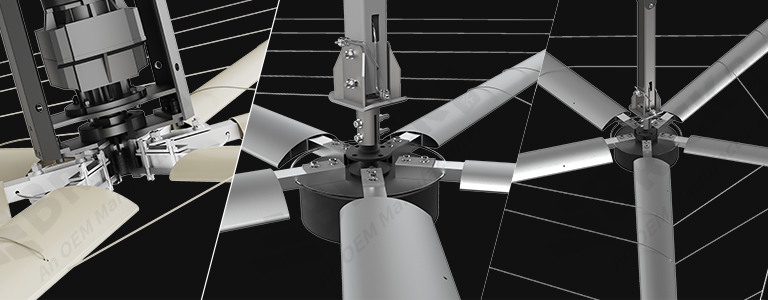
Brick has obtained two utility model patents for aluminum-plastic composite blades.
Patent Nos.: ZL 2022 2 0179655. X, ZL 2022 2 0166880. X
Currently, aluminum-plastic composite blades are used in extra-large ceiling fans with a fan diameter of up to 4.9 meters.
More than 1,000 units of aluminum-plastic composite blades have been installed on the market, with the longest operating time being 3 years, indicating that the technology is maturing.
Aluminum-plastic blade specifications are: 4.9 m/16 Ft., 4.6 m/15 Ft., 4.3 m/14 Ft., 4 m/13 Ft., 3.7 m/12 Ft., 3.3 m/11 Ft.
Plastic blades are widely used in both residential and commercial markets, with a market share far exceeding that of metal blades. Therefore, there is no market doubt regarding the usability, durability, and safety of plastic blades.
The main reason why Birec can substantially increase the length of plastic blades is by embedding a metal skeleton within the plastic blade's outer shell, overcoming the performance limitations of plastic. In fact, the sag and shear strength of the metal skeleton are the same as comparable pure aluminum alloy blades. The plastic blade does not bear any radial load, and its strength in the circumferential direction is partially dependent on the metal skeleton. Birec uses PC (polycarbonate), commonly known as a plastic alloy, as the base material for the outer shell. Its strength and durability are superior to the shells of household appliances and automotive headlights, with literature reporting a normal service life of over 5 years.
The process of embedding the metal skeleton and plastic shell within the plastic blades has the following characteristics:
A) The metal skeleton meets the strength and load-bearing requirements of the blade in the length direction;
B) The plastic shell meets the fan's requirements for airflow, air pressure, airflow, and coverage area;
C) Engineering adhesive is used to fill the gap between the metal skeleton and the plastic shell to prevent blade breakage due to inconsistent coefficients of thermal expansion;
D) The composite structure of the metal skeleton and plastic shell can prevent structural resonance caused by fan vibration.
E) Low manufacturing cost
Under the premise of meeting usage requirements and ensuring safety, aluminum-plastic composite blades are more competitive in the market and bring greater benefits to customers.
Besides Brick using plastic blades, other pioneering brands of extra-large ceiling fans also use composite material blades.
Other brands use pure composite material structures without embedded metal supports. This manufacturing process is very mature; extra-long wind turbine blades are manufactured using composite resin coating technology. Hengzhengtong's first-generation products used blades made with carbon fiber resin coating.
Hengzhengtong's main reason for using aluminum-plastic composite blades is to consider product cost; the resin coating process is time-consuming, has low output, and produces a strong resin odor at the processing site.
Brick believes that aluminum-plastic composite blades will definitely gain a place in the extra-large ceiling fan market.
The inspiration for the Internet-connected blade safety net came from a real blade breakage accident.
The massive ceiling fan involved in the accident was equipped with fall arrestors. When a blade unexpectedly broke, the fall arrestors prevented the blade from falling to the ground. However, in a multi-story factory building, the blade height was approximately 5 meters, and the fan was still rotating. The broken blade hung suspended in the air, spinning like a sword. The owner later told us that if the blade had broken, they would have preferred it to fall, because the damaged area of a blade swirling in the air was far greater than the area of a single falling blade.
Learning from this experience, we invented the interconnected blade fall arrestor. Its effectiveness depends on the condition that the blades fall individually. The remaining healthy blades can support the falling blade, providing overall support from root to tip.
We believe the interconnected fall arrestor can be compared to a car seatbelt. Under normal circumstances, it's an unnecessary device, even making the fan seem somewhat cumbersome. However, in the instant a blade falls, it can protect the safety of people below. On the other hand, some skeptics point out that the nylon rope cannot bear the weight or may age. Brick recommends that customers replace the nylon rope regularly (every five years). However, in the instant the blade falls, the crowd below only needs 1-2 minutes to evacuate, and the internet only needs to play a role in these 1-2 minutes.
The following comparison focuses specifically on the different configurations of Brick extra-large ceiling fans:
| Project | Gear motor | Permanent magnet direct drive motor - external rotor |
| Brand and manufacturing quality | Nord geared motors from Germany Over 10 years of experience in ultra-large ceiling fan applications. Stable quality and durable. Made in China from a wholly-owned German factory Alternative motor: Shih-Yuan Motors from Taiwan | Local manufacturing plant. 5 years of experience manufacturing extra-large ceiling fan motors. |
Technology maturity Reliability Advantages and disadvantages | Highly mature and relatively reliable in quality. The durability of the gearbox has been proven in the market; most gearboxes for motors over 10 years old operate normally without any maintenance. Gearbox drives have low transmission efficiency, and their biggest drawback is high noise! The effective working time of an extra-large ceiling fan is approximately 6-9 months per year. For the gearbox, the workload is low, and annual maintenance and gear oil changes are not required. The annual inspections requested by some customers mainly focus on fan blades, fastening bolts, and stabilizing steel cables, etc. These maintenance items are also necessary for extra-large ceiling fans with permanent magnet direct drive motors. | Extra-large ceiling fans utilize low-speed, high-torque motors. Besides the grade of the permanent magnet material, the thickness of the copper wire, and the insulation treatment process, the design and assembly quality of the mechanical structure also significantly impact the motor. In particular, consistency and stability of quality are crucial for extra-large ceiling fans! This is also the most challenging aspect for small and medium-sized manufacturing enterprises in China. For customers, the biggest advantage of using a permanent magnet direct-drive motor is quiet operation, not necessarily maintenance-free operation! For manufacturers, it offers simple installation, fewer parts, and lower costs. |
For popular aluminum alloy extruded blades, Brick is the only brand that uses a lateral fastening method between the blade and the blade holder.
Brick launched popular aluminum alloy extruded blades primarily to respond to market demands for more competitive pricing, enrich its product line, and facilitate more specific and detailed comparisons between products with similar manufacturing processes.
With 14 years of experience in repairing and maintaining extra-large ceiling fans, we have handled a significant number of aluminum alloy extruded blade fracture incidents and analyzed their causes. Our repair work revealed that 99% of fractures occurred at the blade root fastening bolts. Furthermore, these bolts fasten the blade and blade holder/clamp by penetrating the blade housing from top to bottom. Observation showed that the bolt threads cut through the screw holes, enlarging them and leading to fracture.
Brick approach to this is to systematically strengthen the connection points. Two 4mm thick through-type vertical ribs are incorporated into the blade's inner cavity to enhance its overall rigidity. The bolt connection between the blade shank and blade is replaced with a connection between the shank and the blade's vertical ribs, creating a horizontal and transverse connection. An expansion groove is cut into the upper surface of the blade shell; when the shank and rib are tightened, the groove compensates for any misalignment, preventing blade deformation or indentation.
The biggest challenge in transverse tightening is the need to drill holes on the side of the blade, a complex and costly process.
To ensure the blade's long-term safety, Birui Technology has opted for a more complex approach, eliminating potential hazards.
The motor drives the blades, generating airflow. The perceived performance of a large ceiling fan is reflected in three factors: airflow, air pressure (wind feel), and effective coverage area.
Assuming the blade shape, diameter, and rotational speed are the same, the blade angle of attack significantly impacts these three factors, and the angle of attack also determines the motor power.
Increasing the angle of attack increases airflow and effective coverage area, but also increases energy consumption. According to relevant literature, most blades with uniform cross-sections use the NACA44** blade shape, with a recommended angle of attack range of 12-18°. Lowering the angle of attack reduces airflow but enhances the wind feel and reduces energy consumption.
With a fixed blade shape, optimizing the angle of attack can balance airflow, wind feel, and effective coverage area to achieve optimal output flow (airflow).
Under current permanent magnet direct drive technology, overemphasizing low motor power effectively reduces the angle of attack, sacrificing airflow and effective coverage area. While a strong wind feel (wind pressure) may be achieved, the lack of airflow makes it difficult to fulfill the basic ventilation and cooling function of a large ceiling fan.